
What Is a Scrum Master? Role, Salary, Certifications and Career Path (2026 Guide)
Updated: 1 July 2026, 11:21 pm IST
Table of Content
Who Is a Scrum Master?
Who Should Become a Scrum Master?
The Scrum Framework: What Every Scrum Master Works Within
What a Scrum Master Actually Does?
Scrum Master vs Project Manager
Qualifications and Eligibility to Become a Scrum Master
Scrum Master Salary: What You Can Actually Earn in 2026
Scrum Master Certification: Which One to Pick in 2026
How to Become a Scrum Master in 2026: Step by Step
Scrum Master Career Path and Growth
Can a Non-Technical Person Become a Scrum Master?
Skills That Separate Good Scrum Masters From Great Ones
The Scrum Master in 2026: Where AI Fits In
Scrum Master: Growth & Trends
Conclusion
A scrum master is a servant-leader who ensures agile teams follow the Scrum framework, removes blockers, and drives continuous improvement. The average scrum master salary in India is Rs 15.75 LPA.
In the US, it sits at $126,000 per year. A scrum master certification can increase your earning potential by 15 to 30%, depending on which credential you hold.

Who Is a Scrum Master?
Short answer to who is a scrum master: A scrum master is the person who clears the path so the team can run. Not a boss. Not a task assigner. Not a project manager with a new title.
A scrum master is a servant-leader. Their job is to protect the team's focus, remove every obstacle slowing them down, and make sure the Scrum framework is being used correctly.
They lead by serving, which sounds soft until you watch a skilled one turn a dysfunctional team into a high-velocity delivery machine inside six weeks.
The role was formalised by Ken Schwaber and Jeff Sutherland in the early 1990s as part of the Scrum framework. It started in software development. Today, it runs across banking, healthcare, insurance, manufacturing, and retail.
| Scrum Master is a fast-growing career path, with job demand projected to rise by 17.4% by 2028. |
|---|
Businesses are not hiring Scrum masters just to run meetings anymore. They want people who can coach teams, lift sprint velocity, reduce waste, and show measurable improvement every single cycle.
Who Should Become a Scrum Master?
The role fits people who are organised but flexible. You can become a scrum master if you have the following qualities:
- Detail-oriented but not rigid
- People-focused but results-driven
It is a natural path for software developers who want to move into people-focused roles, project coordinators transitioning into Agile environments, business analysts with strong stakeholder experience, and recent graduates who want a structured entry into tech without needing to code.
However, it is not a good fit for people who need formal authority to feel effective, or for those who are uncomfortable navigating ambiguity and interpersonal tension. The scrum master role lives in both constantly.
The Scrum Framework: What Every Scrum Master Works Within
Before understanding the role fully, you need to understand the system a scrum master operates within. Scrum organises work into fixed cycles called Sprints, usually one to four weeks long. Each Sprint has a goal, a committed workload, and ends with a working product increment. Three roles make up every Scrum team.
| Role | Primary Responsibility |
|---|---|
| Scrum Master | Process, team health, removing blockers |
| Product Owner | Priorities, backlog, stakeholder communication |
| Development Team | Building and delivering the increment |
Scrum teams are intentionally small, with 10 or fewer members, to support communication, collaboration, and productivity. Every Sprint runs through four ceremonies. The scrum master facilitates all four.
- Sprint Planning sets the goal and workload for the cycle.
- The Daily Standup is a 15-minute morning sync: what did you do yesterday, what are you doing today, what is blocking you.
- The Sprint Review is a live demonstration of completed work to stakeholders.
- The Sprint Retrospective closes the Sprint with honest reflection: what went well, what did not, and what one thing the team will improve next cycle.
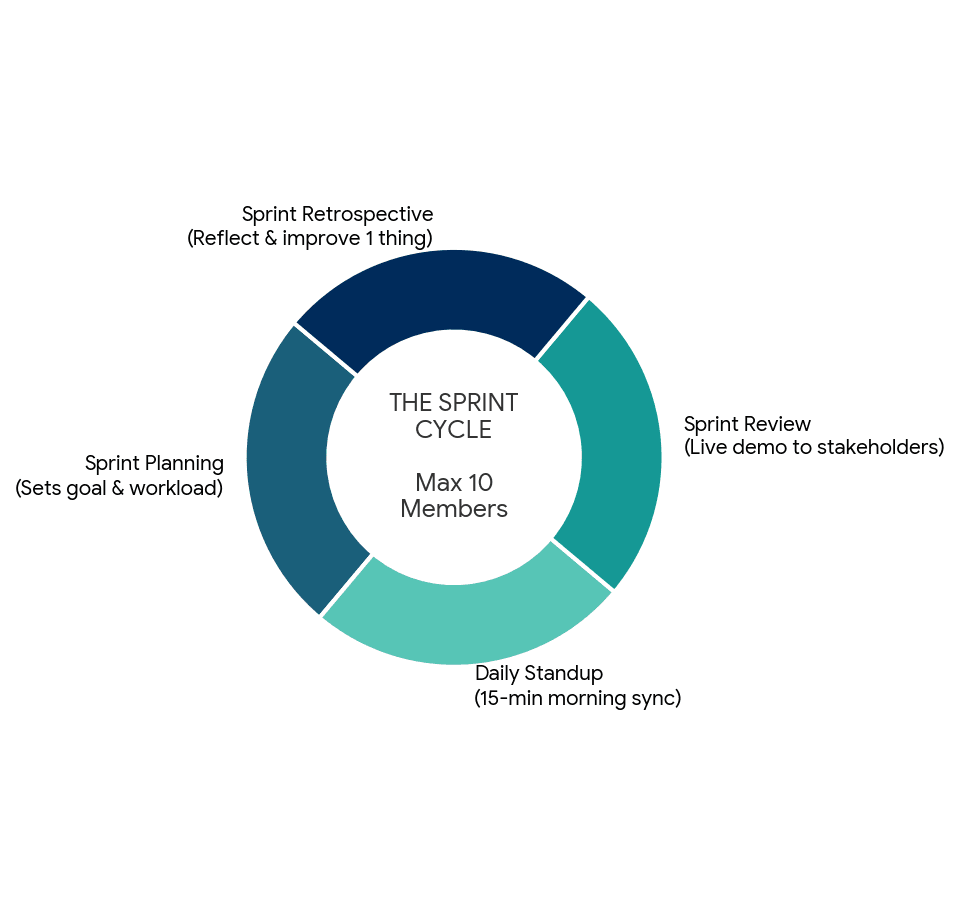
The Scrum Master is responsible for scheduling and facilitating daily stand-ups, sprint planning, reviews, and retrospectives, ensuring that these meetings are productive and that all team members have a voice in the process. Three artefacts support the ceremonies.
- The Product Backlog is the full list of work the product needs.
- The Sprint Backlog is what the team commits to for the current Sprint.
- The Increment is the usable output at the end.
A scrum master does not own these artefacts but is responsible for making sure the team uses them properly.
What a Scrum Master Actually Does?
The main responsibilities of the Scrum Master include:
- Facilitating Scrum events such as Sprint Planning, Daily Scrum, Sprint Review, and Sprint Retrospective
- Coaching the Scrum Team in understanding and applying the Scrum framework
- Actively identifying and removing any obstacles or impediments that may hinder the team's progress
- Safeguarding the Scrum Team from external disruptions.
Here is what the role looks like in practice, not in theory.
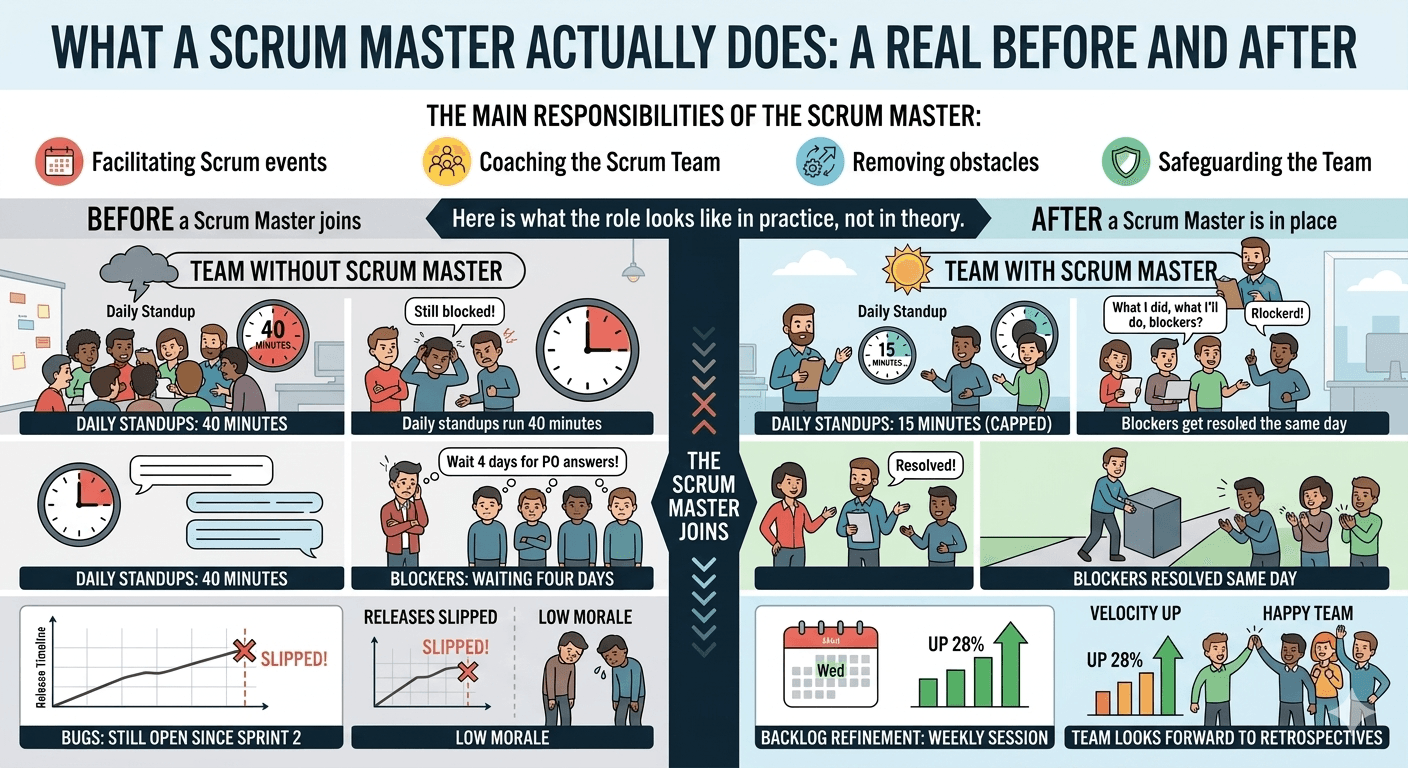
Before a Scrum Master joins: Daily standups run 40 minutes. Developers wait four days to get backlog answers from the product owner. Bugs from sprint two are still open in sprint five. The last release slipped by three weeks. Team morale is low.
After a Scrum Master is in place: Standups are capped at 15 minutes with a clear format. Blockers get resolved the same day. The product owner does a 30-minute backlog refinement session every Wednesday. By sprint four, velocity is up 28%. The release holds. The team starts looking forward to retrospectives.
Beyond those, a skilled scrum master in 2026 also:
- Tracks sprint velocity and burndown charts using tools like Jira
- Facilitates conflict resolution within the team
- Coaches the product owner on backlog refinement
- Reports sprint health metrics to senior stakeholders
- Drives continuous improvement through retrospective action items
- Mentors junior team members on Agile principles
A scrum master keeps the overall overview of all activities while helping the teams involved to analyse both technical and organisational aspects of the project at hand to avoid any pitfalls during the process. This fosters transparency and accountability and helps the teams meet their deadlines.
Scrum Master vs Project Manager
People mix these two up constantly. Here is the clearest way to separate them.
The project manager owns the outcome. A scrum master owns the process.
The Scrum Master focuses on team effectiveness, framework adherence, and value delivery through iterative cycles. Understanding this distinction prevents role misalignment and protects team autonomy within agile environments.
| Scrum Master | Project Manager | |
|---|---|---|
| Authority | No direct authority | Controls scope, budget, timeline |
| Focus | Team process and health | Delivery milestones |
| Leadership | Servant-leader | Directive |
| Planning | Sprint-by-Sprint, iterative | Linear, milestone-based |
| Success metric | Team velocity, improvement | On-time, on-budget |
In product companies and startups, the scrum master has largely replaced the project manager in software delivery. In large enterprises, both roles coexist because financial governance still requires formal project oversight.
Qualifications and Eligibility to Become a Scrum Master
There isn’t any mandatory degree or an exact educational background you need to become a Scrum Master. Though in real life, many employers still lean on applicants who hold a bachelor’s degree.
People from business backgrounds, information technology, computer science, engineering, or project management can go for this course.
And yes, people coming from non-technical backgrounds can still go in this direction too, as long as they genuinely grasp Agile principles and how Scrum works in day-to-day delivery.
- If you want to be considered for Scrum Master roles, you should build a firm understanding of the Scrum framework, Agile methodologies, how teams collaborate, and the whole project delivery process.
- Getting a recognised Scrum certification, like Professional Scrum Master (PSM I) or Certified ScrumMaster (CSM), can noticeably help. It also acts like a signal to employers that you know the basics without guessing.
On top of that, strong communication, leadership, problem-solving, conflict handling, and facilitation skills matter a lot.
Some entry-level Scrum Master positions may accept people with little experience, but a lot of organisations still prefer candidates who previously worked inside Agile teams, in project coordination, software development, product management, or in similar roles, before they hand them Scrum Master responsibilities.
Scrum Master vs Agile
Agile is more like a mindset, the general way of thinking. Scrum is one of the frameworks that actually follows that mindset, not the whole idea itself. Agile is broader, and it leans into things like flexibility, cooperation, ongoing learning, and delivering value fast. Scrum is just one practical path teams use to put those ideas into action.
A Scrum Master is not “Agile” itself. Nope. A Scrum Master helps the team stick to the Scrum framework in a way that still respects Agile values. Usually, they focus on getting rid of blockers, facilitating the Scrum events, and encouraging continuous improvement within the team.
If you need a quick memory trick, it’s like this:
Agile = Philosophy, or mindset
Scrum = A framework that follows those Agile ideas
Scrum Master = The person who helps the team succeed with Scrum
So when someone says they are “doing Agile,” they might actually be using Scrum, Kanban, or another Agile method entirely. A Scrum Master specifically operates inside Scrum, not inside Agile in general. It’s a small distinction, but if you catch it early, it can really reduce confusion when you start your Agile journey.
Scrum Master Salary: What You Can Actually Earn in 2026
Scrum Master Salary in India
The average scrum master salary in India is Rs 16.26 LPA based on 2,923 Glassdoor submissions as of March 2026.
The typical range runs from Rs 10.47 LPA at the 25th percentile to Rs 23.32 LPA at the 75th percentile. Top earners hit up to Rs 31.48 LPA at the 90th percentile. (Glassdoor)
| Experience Level | Scrum Master Salary in India |
|---|---|
| Fresher (0 to 1 year) | Rs 5 to 8 LPA |
| Early career (1 to 4 years) | Rs 9 to 13 LPA |
| Mid-level (4 to 7 years) | Rs 14 to 22 LPA |
| Senior (7+ years) | Rs 25 to 35 LPA |
City makes a significant difference. The average scrum master salary in India, specifically in Bangalore, is Rs 16 LPA, with top earners reaching Rs 28 LPA, based on 852 Glassdoor submissions as of February 2026.
| City | Average Annual Salary |
|---|---|
| Bangalore | Rs 16 LPA |
| Hyderabad | Rs 14 to 18 LPA |
| Pune | Rs 13 to 17 LPA |
| Mumbai | Rs 13 to 16 LPA |
| Noida/Gurugram | Rs 12 to 16 LPA |
SAFe Scrum Master certification adds a 20 to 30% salary premium in India. CSM adds 15 to 25%. Product companies pay 30 to 50% more than IT services firms for the same experience level.
Companies paying above-average scrum master salary in India include Amazon, Microsoft, Google, Walmart Global Tech, Flipkart, Visa, and Accenture.
Scrum Master Salary: United States and Global
The median total pay for a scrum master in the US is $126,000 per year. Senior professionals with SAFe or PSM III credentials can push well past $150,000 in tech hubs like San Francisco, Seattle, and New York.
| Country | Average Annual Salary |
|---|---|
| United States | $126,000 |
| United Kingdom | GBP 55,000 to 70,000 |
| Canada | CAD 90,000 to 110,000 |
| Germany | EUR 60,000 to 80,000 |
| India | Rs 14 to 20 LPA |
Scrum Master Certification: Which One to Pick in 2026
Certifications are not just resume decoration. Employers actively filter for them. A scrum master certification signals that you understand the framework at a level beyond just attending standups. Here are the four main options.
Certified ScrumMaster (CSM) by Scrum Alliance
The most widely recognised entry-level credential in the market. The CSM costs between $500 and $2,000 in the US, includes training, exam, and a 2-year membership. Renewal every 2 years costs $100 plus 20 Scrum Education Units. You must attend a 2-day instructor-led training course before the exam.
Professional Scrum Master (PSM I) by Scrum.org
The learner has a more affordable path to a scrum master certification. The PSM I exam costs $200 USD per attempt. Test passwords do not expire and remain valid until used. No mandatory training required. You study the Scrum Guide, practice on Scrum.org's free open assessments, and sit when ready. PSM I, II, and III form a progressive ladder. PSM III is considered the most rigorous scrum master certification in the industry.
SAFe Scrum Master (SSM) by Scaled Agile
Built for professionals working in large organisations that run multiple Scrum teams across big programs. SSM costs between $550 and $750, requires a 2-day training, and carries an annual renewal fee of $100. If your company uses the Scaled Agile Framework, this is essential.
Advanced Certified ScrumMaster (A-CSM)
The natural next step after CSM. A-CSM training costs between $800 and $1,200, with renewal every 2 years costing $175 plus 30 Scrum Education Units. It goes deep on practical facilitation, coaching, and navigating real team complexity.
| Certification | Cost (USD) | Validity | Best For |
|---|---|---|---|
| Certified Scrum Master (CSM) | $500 to $2,000 | 2 years | Beginners and job seekers |
| PSM I | $200 | Lifetime | Budget-conscious professionals |
| SSM (SAFe) | $550 to $750 | 1 year | Enterprise Agile teams |
| A-CSM | $800 to $1,200 | 2 years | Experienced CSM holders |
Good to know: A certified scrum master consistently earns more than a non-certified one. Companies offer higher salaries for certified Scrum Masters who can effectively coach teams and drive Agile adoption. Professionals with multiple certifications can negotiate better salary packages.
How to Become a Scrum Master in 2026: Step by Step
If you want to become a scrum master, you need to follow a few simple steps as shown below:
- Step 1: Read the Scrum Guide. Download it free from Scrum.org. It is 13 pages. It is the foundation of every scrum master certification exam. Read it until you can explain any part of it without looking.
- Step 2: Get Certified. PSM I for the affordable self-study route. CSM, if you want structured training with a cohort. Both are valid entry points.
- Step 3: Get Hands-On Experience. Volunteer to facilitate team retrospectives. Shadow an experienced scrum master. Join your company's next Agile project and observe how ceremonies are run.
- Step 4: Master the Tools. Every employer expects working knowledge of Jira for sprint boards and velocity tracking, Confluence for team documentation, burndown charts for Sprint progress visualisation, and Miro or MURAL for remote retrospective facilitation.
- Step 5: Build a Results-Focused Resume. Do not write "facilitated daily standups." Write "improved sprint velocity by 25% over four cycles by restructuring planning and introducing a same-day blocker resolution protocol."
- Step 6: Level Up With Advanced Credentials. Once you have 2 to 3 years of experience, move toward PSM II, A-CSM, or SAFe. Career evolution may include positions such as Agile Coach, Delivery Lead, or transformation consultant. Continuous learning and field experience remain the strongest differentiators in 2026.
Scrum Master Career Path and Growth
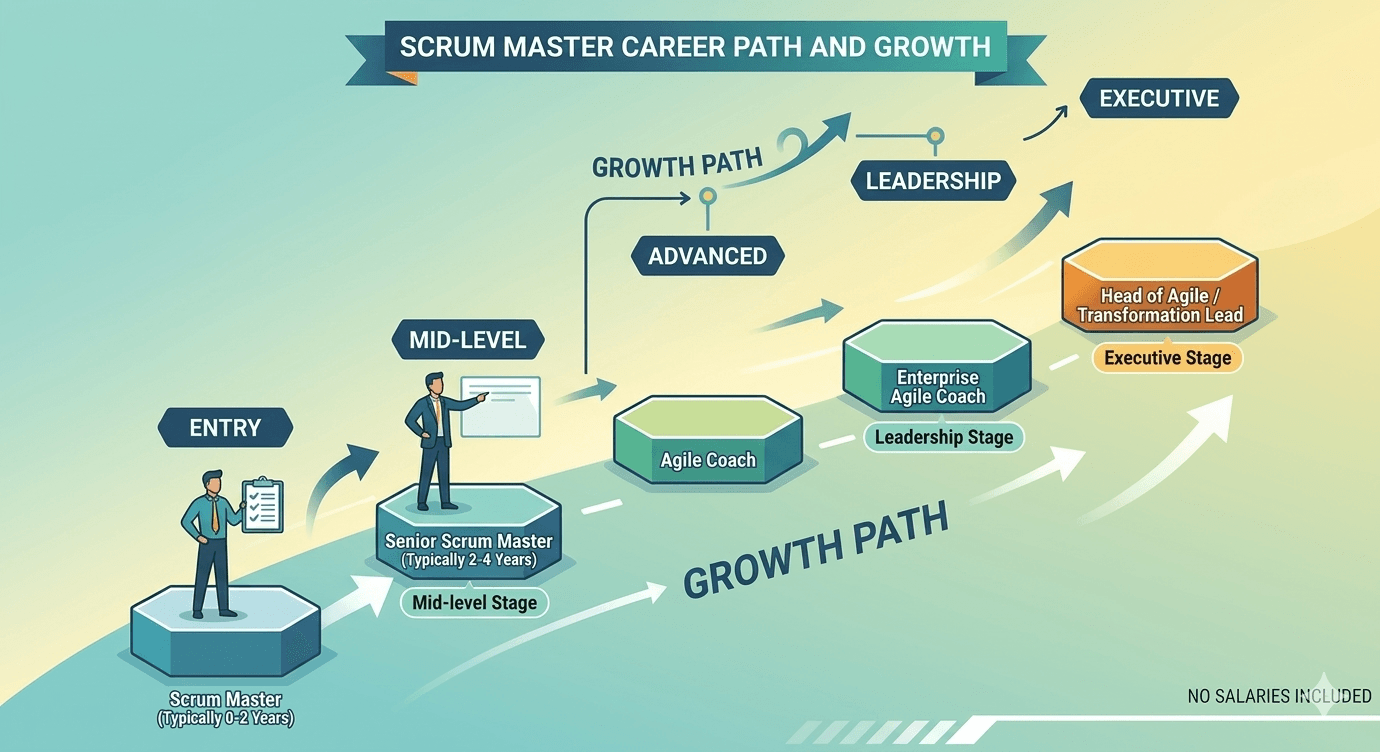
The certified scrum master who builds deep coaching skills and scaled Agile experience typically makes the jump to Agile Coach within four to five years. From there, the earning ceiling rises sharply.
| Stage | Role | Salary in India |
|---|---|---|
| Entry | Scrum Master | Rs 6 to 10 LPA |
| Mid-level | Senior Scrum Master | Rs 15 to 22 LPA |
| Advanced | Agile Coach | Rs 25 to 40 LPA |
| Leadership | Enterprise Agile Coach | Rs 40 to 60 LPA |
| Executive | Head of Agile / Transformation Lead | Rs 50 LPA and above |
Can a Non-Technical Person Become a Scrum Master?
Yes, you can become a scrum master even if you don’t have technical knowledge.
One of the common misconceptions about the SCRUM Master role is that you have to be a software developer or a proficient coder. In practice, Scrum Masters work on team facilitation, Agile coaching, communication, problem-solving, and process improvement rather than coding.
While it helps to have technical knowledge of how software teams work, it is not necessary. A lot of successful scrum masters are not from technical backgrounds, and they transition to agile after getting good scrum knowledge and a scrum certification.
People from the following backgrounds often become good Scrum Masters.
| Previous Background | Transferable Skills |
|---|---|
| Human Resources (HR) | Coaching, conflict resolution, and people management |
| Operations | Process improvement, workflow optimisation |
| Project Coordination | Scheduling, stakeholder communication, and team coordination |
| Customer Success | Relationship management, problem-solving, facilitation |
| Business Analysis | Requirements gathering, stakeholder engagement |
| Quality Assurance (QA) | Attention to detail, Agile team collaboration |
| Training and Learning & Development | Coaching, mentoring, workshop facilitation |
| Support and Service Delivery | Cross-functional collaboration, issue resolution |
For non-technical professionals, the recommended course is quite simple.
- Get acquainted with Agile and Scrum basics.
- Go through the Scrum Guide.
- Acquire a certification that is recognized, like PSM I or CSM.
- Get exposure working on Agile teams or projects.
- Cultivate the ability to facilitate and coach.
The most capable Scrum Masters aren't necessarily the most technical people. The most effective communicators, facilitators, and coaches are often. If you like supporting teams succeed, resolving disputes, facilitating conversations, and encouraging progressive improvement, you can choose a career in Scrum Master without a technical background.
Skills That Separate Good Scrum Masters From Great Ones
Technical knowledge is the baseline. These are what push you to the top.
- Hard Skills: Deep knowledge of the Scrum Guide and Agile Manifesto. Proficiency in Jira, Confluence, and burndown charts. Understanding of Kanban, SAFe, and LeSS frameworks. Sprint metrics fluency: velocity, cycle time, lead time, defect escape rate.
- Soft Skills Conflict facilitation. Servant-leadership mindset. Active listening. Stakeholder communication at every level. Coaching and mentoring. The ability to influence without authority.
Also Read: Kanban vs Scrum: Which Agile Methodology is Better?
| Most people get the scrum master certification easily. The ones who build lasting careers are the ones who develop real coaching skills and consistently show velocity improvement across every team they touch. |
|---|
A good scrum master should be collaborative, implementing the spirit of teamwork and togetherness during product development, and influential enough to drive process improvements without direct authority.
The Scrum Master in 2026: Where AI Fits In
AI is changing the day-to-day of a scrum master in specific, measurable ways.
- Tools like Geekbot and Jira's AI summaries now auto-generate standup updates from ticket activity. This frees up the scrum master from logistics and shifts focus to deeper coaching work.
- AI-driven velocity forecasting uses historical sprint data to predict completion dates with significantly better accuracy than manual tracking.
- Retrospective analysis tools can now surface recurring patterns across multiple sprints and flag chronic blockers before they compound.
| What AI cannot replace: reading team morale in a room. Navigating interpersonal conflict. Building trust with a sceptical stakeholder. Coaching a developer through burnout. These are deeply human skills, and they are precisely what employers pay a premium for in 2026. The scrum master who combines strong coaching instincts with fluency in AI-assisted sprint tools is the most competitive professional in the Agile job market right now. |
|---|
Will AI Replace Scrum Masters?
No, AI can’t replace scrum masters, and here’s why:
AI can automate:
- Standup summaries
- Sprint reporting
- Velocity forecasting
- Retrospective analysis
AI cannot effectively:
- Resolve conflicts
- Build trust
- Coach teams
- Influence stakeholders
- Drive organizational change
The future Scrum Master will use AI as a productivity tool rather than compete against it.
Also Read: Impact of AI on The Job Market And Future Careers
Scrum Master: Growth & Trends
The demand for skilled scrum masters in India is growing fastest in Bangalore, Pune, Hyderabad, and Gurugram, driven by GCC expansion, SAFe adoption in large enterprises, and Agile penetration into the BFSI and healthcare sectors.
Three structural trends make demand for skilled Scrum Masters durable in India through 2026 and beyond:
- Indian enterprises are scaling Agile into BFSI, manufacturing, and healthcare
- GCCs are expanding rapidly across Bangalore, Hyderabad, and Pune
- SAFe adoption is growing in large enterprises, creating specific demand for Scrum Masters with scaled framework experience.
If you are serious about this career, get your first scrum master certification. Get practical experience on a real team as fast as you can. The gap between a certified professional with real sprint data on their resume and someone without is enormous at the hiring stage.
Take the next step in your career ?
Conclusion
Scrum Master has become one of the most valuable roles in Agile teams, combining leadership, coaching, and process improvement. It ensures promising career growth with average salaries of Rs 15 to 20 LPA in India and has a demand in all industries.
Becoming a certified Scrum Master and gaining experience and communication ability can advance you to higher levels of leadership. The Scrum Master will be in demand as organisations invest more in Agile delivery.
ABOUT AUTHOR

Similar Blogs

Apply Now
Apply Now
frequently asked questions
What is a Scrum Master, and how do you become one?
+A Scrum Master facilitates an agile team to come together as a working unit. They clear obstacles, conduct Scrum meetings, and ensure that the team is using Scrum practices properly. To become one, learn about the Scrum framework, read the Scrum Guide, get certified as a PSM I or a CSM, and get some real-world experience in leading Agile teams.
What do Scrum Masters do?
+A Scrum Master conducts the Scrum ceremonies, clears impediments, keeps the team from being distracted, mentors the team on Agile, and supports the team to increase their effectiveness. They also collaborate closely with the Product Owners and stakeholders to ensure that the work operates efficiently.
What qualifications are required to become a Scrum Master?
+There is no requirement to have any particular degree to become a Scrum Master. The majority of employers prefer to hire someone with a bachelor's degree and knowledge of Agile and Scrum. Professional credentials such as PSM I or CSM can boost your resume, particularly if you are new to the position.
Is Scrum Master a technical role?
+Not necessarily. The Scrum Master is not a coder, software developer or software builder. But it is beneficial to have some knowledge of how Software teams operate. A lot of effective Scrum Masters are not technical, for example, operations, business analysis, HR or project coordination.
What is the average Scrum Master salary in India?
+The average pay of Scrum Masters in India is approximately Rs 15-16 LPA. Salaries vary by experience, certification, company and location. Product companies and global capability centres tend to pay higher than traditional IT services companies.
What is the salary of a Scrum Master with 5–7 years of experience?
+The salary of a Scrum Master in India ranges from Rs 14 LPA to Rs 22 LPA, based on 5-7 years of experience. Those who have advanced-level certifications and experience in larger Agile environments can make even more money.
Which Scrum Master certification is best for beginners?
+The most popular options for beginners are the PSM I and CSM courses. PSM I is less costly, and there is no requirement for training. For those who prefer guided learning, CSM provides instructor-led learning, which can be a great choice.
What is the difference between a Scrum Master and a Project Manager?
+A Project Manager has the responsibility for managing budgets, timelines, scope and the overall delivery of projects. A Scrum Master is someone whose job it is to make the team effective, work with the agile processes and continuously improve. One carries out the project, and the other one helps the team and the process.
What is the difference between Scrum Master and Product Owner?
+The Product Owner determines the work the team should do and is responsible for the product backlog. A Scrum Master assists the team to do that work efficiently by helping them implement Scrum practices and eliminating impediments. In other words, the Product Owner is interested in knowing the "what", and the Scrum Master is interested in knowing the "how.
Is Scrum Master still a good career in 2026?
+Yes. Businesses are still pouring resources into Agile delivery, digital transformation and scaled Agile frameworks. Thoughtful Scrum Masters are still needed, as they assist teams in meeting the needs of their businesses, working efficiently, and working together.