
ACCA: Course Details, Duration, Fees, and Career Options
Updated: 8 October 2026, 11:25 am IST
Table of Content
Introduction
What is ACCA?
ACCA's Future Qualification: Key Changes Coming in 2027
Why Choose to Study the ACCA Course?
Who Should Pursue ACCA?
ACCA Course Details, Duration, Syllabus, and Fees
How Many Years Is the ACCA Course?
ACCA Exam Pattern and Passing Criteria
ACCA Course Structure and Levels
ACCA vs CA
How to Become an ACCA Member
ACCA Salary in India and Abroad
ACCA Admission Process (Step-by-Step)
Documents Required for ACCA Registration
ACCA Signing Authority by Country
Top Recruiters Hiring ACCA Professionals
Is ACCA Worth It in 2026?
What are ACCA career opportunities after the course?
Conclusion
Introduction
ACCA is a global professional accounting body that supports and recognises professional accountants worldwide. With a network of more than 110 offices and a presence in over 180 countries, ACCA offers candidates the designation of Chartered Certified Accountant once they complete the course.
The courses offered by ACCA help prepare candidates for the financial and management aspects of a business and develop the skills required for modern accounting and finance roles. They prepare professionals to work across industries and global organisations.
This blog explains what ACCA is, the ACCA full form, and important ACCA course details such as eligibility, course duration, course syllabus, and course fees. It also highlights ACCA career opportunities and how this global accounting qualification can help students and professionals build international careers in finance and accounting.

What is ACCA?
The Association of Chartered Certified Accountants (ACCA) is a membership body that supports and accredits professional accountants globally. Since it was founded in 1904, the organisation has been helping professionals pursue rewarding careers in accountancy by creating globally recognised accounting qualifications.
The role of accountants is crucial in maintaining financial transparency and stability. Well-trained accountants help strengthen transparency and accountability, support business growth, and deliver long-term value to organisations.
The ACCA qualification is widely recognised as one of the most respected global accounting credentials for professionals working in finance, auditing, taxation, and corporate management. ACCA is also one of the largest global professional accounting bodies, with members and students across more than 180 countries.
ACCA's Future Qualification: Key Changes Coming in 2027
ACCA is redesigning its qualification to better align with the future of accounting, technology, and business. The updated framework aims to equip students with both technical expertise and workplace-ready skills.
Key changes include:
- A new learning pathway:
Foundations → Knowledge → Expertise → Strategic Professional - Introduction of Essential Employability Modules
- Greater focus on AI, data analytics, sustainability, and business advisory skills
- A new Data Science Professional exam option
- Updated learning resources, including Study Hub and Practice Platform
The transition begins in 2027, with ACCA providing support and clear progression routes to ensure current students can move seamlessly into the future qualification structure. Click here to know more.
Why Choose to Study the ACCA Course?
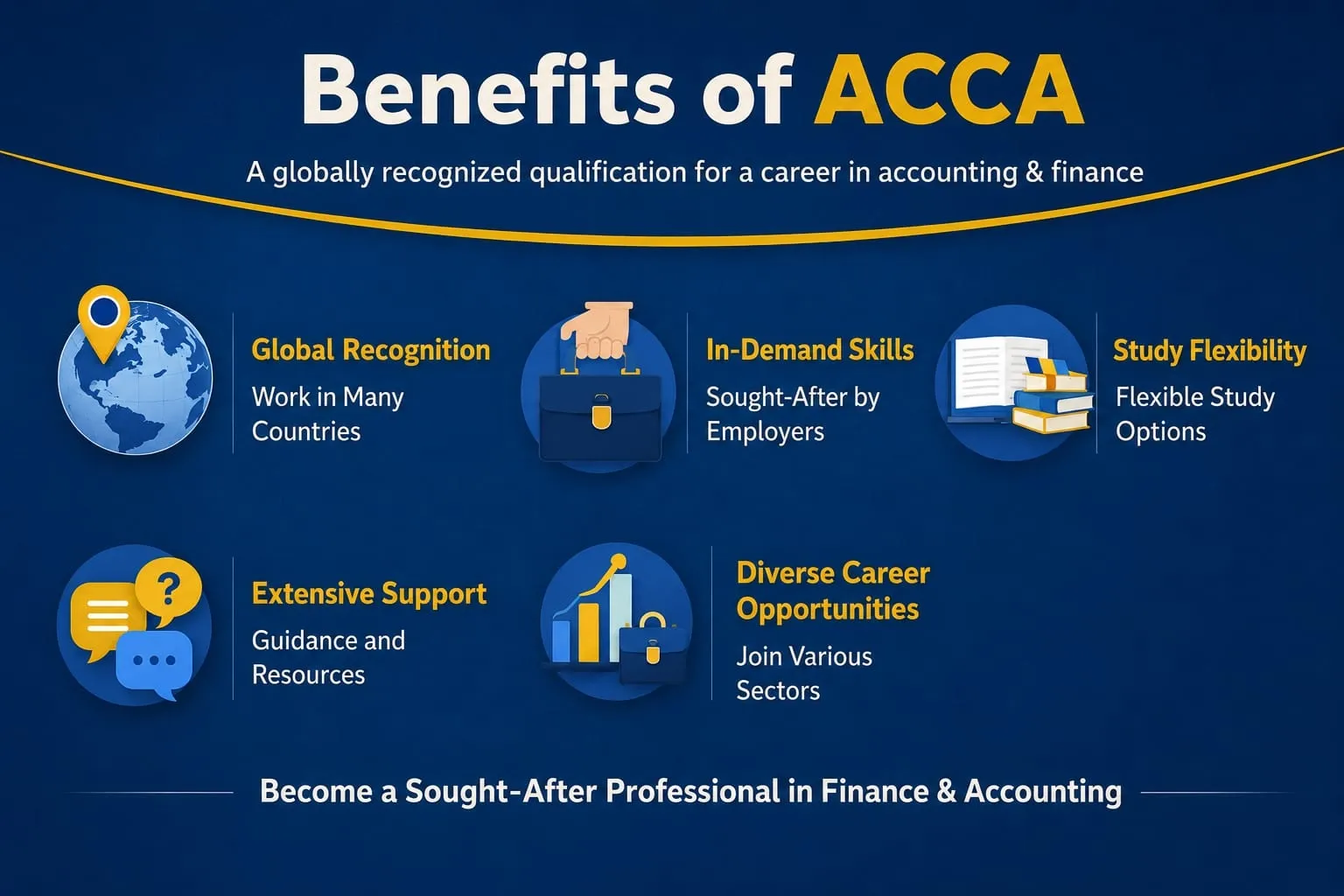
There are several benefits to choosing ACCA, one of the most recognised global qualifications for building a career in accounting and finance. After completing your ACCA qualification, you become a sought-after professional in finance and accounting.
Who Should Pursue ACCA?
Anyone interested in pursuing a career in accounting can join ACCA. Students can start the ACCA course after 12th or after completing a bachelor’s degree. Even finance professionals can pursue the ACCA qualification to improve their career prospects in finance and accounting.
Students who have completed their 10+2 get the flexibility to start the ACCA course and prepare for the exams through a flexible learning structure, which equips them for varied roles beyond accounting. Commerce graduates interested in a career in accounting can also join the ACCA course, which helps them prepare for multiple roles in multinational companies.
Similarly, experienced professionals can upgrade their knowledge, strengthen financial expertise, and prepare for senior roles in finance, accounting, and business management.
Also Read: Common Mistakes to Avoid During ACCA Exams
ACCA Course Details, Duration, Syllabus, and Fees
Students can prepare for the ACCA qualification through ACCA X (ACCA online learning platform) or through ACCA-approved learning partners available across many countries.
The ACCA course syllabus is published on the official ACCA website and is regularly updated to reflect current accounting standards and business practices.
Students are advised to review the latest ACCA course syllabus and exam information on the official website before starting their preparation.
The ACCA course fees vary depending on registration, annual subscription, exam entry fees, and learning support. In India, the total ACCA course fees may range approximately between ₹2,00,000 and ₹3,00,000, depending on exemptions, exam attempts, and the learning provider chosen. The ACCA fee structure includes an initial registration fee, an annual subscription, and individual exam entry fees paid per sitting.
How Many Years Is the ACCA Course?
Most students complete the full qualification, including the practical experience requirement, within three to four years, though the timeline depends on the number of exemptions received and the pace of exam attempts.
ACCA Course Eligibility Criteria
Here is the Minimum eligibility criteria for pursuing ACCA:
- Completed 10+2 or equivalent with a combined score of 65% in Mathematics or Accounting and English, and at least 50% in other subjects.
- Students who have completed 10th grade can sign up for ACCA through the FIA (Foundations in Accountancy) qualification.
- Students who have completed a bachelor’s degree, such as BCom, BBA, or BMS, may also register for the ACCA course and may receive exemptions from some ACCA exam papers depending on their academic background.
Also Read: Benefits of Pursuing ACCA Certification - Course, Qualification
ACCA Exam Pattern and Passing Criteria
ACCA exams are held in four sessions each year: March, June, September, and December. Candidates may attempt up to eight distinct papers in a single calendar year.
The ACCA exam pattern varies across levels. Applied Knowledge papers use objective test questions and multiple-choice questions and are assessed on demand through Computer-Based Exams.
The passing criteria for every ACCA paper are a minimum score of 50 out of 100. This pass mark applies uniformly across all papers, regardless of level or sitting. Papers are assessed independently, so a result in one paper does not affect another.
Pass rates vary across levels and subjects.
| ACCA Level | Typical Pass Rate Range | Difficulty Level |
|---|---|---|
| Applied Knowledge | 60% – 87% | Introductory |
| Applied Skills | 40% – 55% | Moderate |
| Strategic Professional (Optional Papers such as AAA & APM) | 38% – 45% | Advanced |
Note: Pass rates vary by exam session and subject. Applied Knowledge papers generally have the highest pass rates due to their foundational nature, while Strategic Professional papers, such as Advanced Audit and Assurance (AAA) and Advanced Performance Management (APM), are considered among the most challenging ACCA exams.
Also Read: How to Prepare for ACCA Exams: Study Tips
ACCA Course Structure and Levels
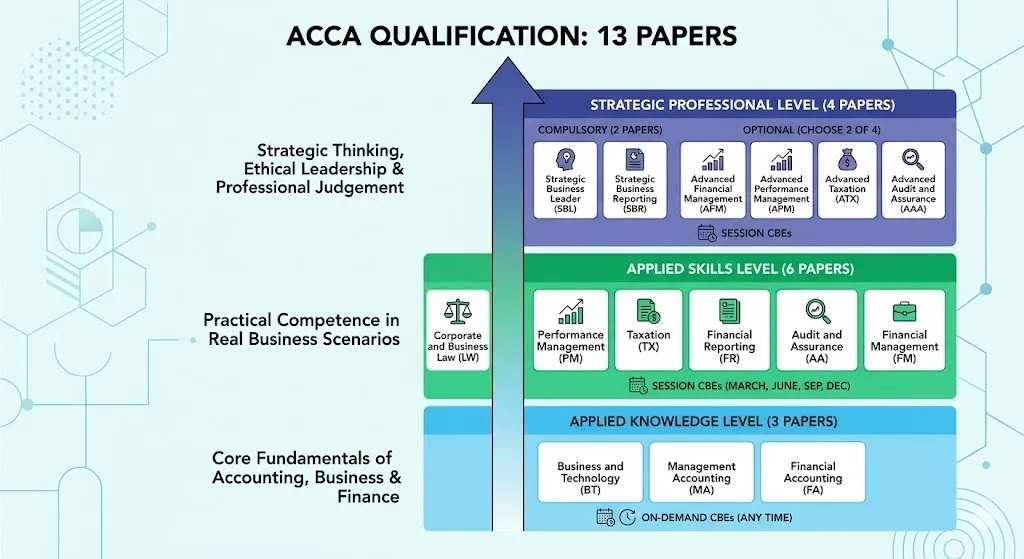
The ACCA course structure is built across three progressive levels, and it consists of 13 papers in total. Each level builds on the foundation of the previous one so that candidates can develop technical knowledge, practical application skills, and strategic leadership capabilities in a structured sequence. Understanding the ACCA course structure is essential for planning the qualification journey effectively.
The ACCA subjects mainly include: financial accounting, management accounting, taxation, law, audit, financial management, and business strategy, among others.
Applied Knowledge Level
The Applied Knowledge Level is the starting point of the ACCA qualification and introduces candidates to the core fundamentals of accounting, business, and finance. This level comprises three papers.
- Business and Technology (BT) covers the structure, governance, and management of organisations, the role of accountants in a business context, and the influence of environmental factors on financial decision-making.
- Management Accounting (MA) develops candidates' understanding of cost accounting, budgeting, performance measurement, and management decision-making techniques.
- Financial Accounting (FA) introduces double-entry bookkeeping, the preparation of financial statements, and the application of accounting standards to basic transactions.
All three papers at this level are available as on-demand Computer-Based Exams (CBEs), meaning candidates can sit them at any time throughout the year at an approved testing centre.
Also Read: Online Courses and Study Programs for ACCA Preparation
Applied Skills Level
The Applied Skills Level builds on the knowledge gained in the first level and develops practical competence across six papers. This level tests a candidate's ability to apply technical knowledge to real business scenarios.
- Corporate and Business Law (LW) covers the legal framework relevant to business, including company law, contract law, and employment law. Candidates can sit the English (LW-ENG) or Global (LW-GLO) variant depending on their country.
- Performance Management (PM) develops skills in costing, planning, control, and performance evaluation, with a focus on supporting management decisions.
- Taxation (TX) covers the application of tax regulations to individuals and businesses. The UK variant (TX-UK) is the most widely taken, though other country-specific variants are available.
- Financial Reporting (FR) focuses on the preparation and interpretation of financial statements in accordance with International Financial Reporting Standards (IFRS), including consolidated accounts.
- Audit and Assurance (AA) covers the principles of external audit, audit planning, evidence gathering, and reporting.
- Financial Management (FM) addresses investment appraisal, working capital management, business finance, and risk management.
These six papers are Session CBEs, meaning they are held in the quarterly exam windows of March, June, September, and December.
Strategic Professional Level
The Strategic Professional Level is the final and most advanced stage of the ACCA qualification. It is designed to develop strategic thinking, ethical leadership, and professional judgement. This level comprises four papers: two compulsory and two optional.
- Strategic Business Leader (SBL) is a compulsory integrated case study paper that tests leadership, governance, risk management, strategy, and digital finance skills in a complex business environment.
- Strategic Business Reporting (SBR) is a compulsory paper focused on advanced financial reporting, including complex IFRS applications, group accounting, and the reporting of sustainability and integrated information.
- For the optional papers, candidates must choose two from the following four: Advanced Financial Management (AFM), Advanced Performance Management (APM), Advanced Taxation (ATX), and Advanced Audit and Assurance (AAA).
The selection of optional papers allows candidates to develop depth in the areas most relevant to their career goals. Candidates who plan to work in audit and assurance, for instance, typically choose AAA as one of their optional papers.
ACCA vs CA
Is ACCA better than CA is one of the most frequently asked questions among commerce students in India. The two qualifications serve different purposes, and the right choice depends on a candidate's career goals.
| Parameter | CA (Chartered Accountant) | ACCA (Association of Chartered Certified Accountants) |
|---|---|---|
| Awarding Body | Institute of Chartered Accountants of India (ICAI) | Association of Chartered Certified Accountants |
| Qualification Structure | Foundation, Intermediate, and Final levels | 13 papers across Applied Knowledge, Applied Skills, and Strategic Professional levels |
| Practical Training | 3 years of mandatory articleship | Practical Experience Requirement (PER), which can be completed alongside employment |
| Typical Course Duration | 4–5 years (including articleship) | 2–4 years, depending on exemptions and exam pace |
| Exam Flexibility | Fixed examination structure | Quarterly exam windows with flexible scheduling |
| Pass Rates | CA Final pass rates have historically ranged from 4%–16% | Skills and Professional level papers typically record pass rates of 40%–55% |
| Global Recognition | Strong recognition primarily within India | Recognised in more than 180 countries |
| Statutory Audit Authority in India | Can sign statutory audit reports in India | Cannot sign statutory audit reports in India |
| Best For | Indian taxation, statutory audit, corporate compliance, and domestic finance careers | Multinational companies, Big 4 firms, Global Capability Centres (GCCs), and international finance careers |
| International Mobility | Limited compared to ACCA | High global mobility across the UK, UAE, Singapore, Australia, and other markets |
| Recognition by Employers in India | Highly valued by Indian corporates and audit firms | Widely recognised by MNCs, Big 4 firms, and IFRS-focused organisations |
| Exemptions | Not applicable | Qualified CAs can receive exemptions from up to 9 ACCA papers |
| Career Focus | Domestic practice and regulatory compliance | Global accounting, finance, reporting, audit, and consulting roles |
| Ideal Choice If... | You want to practise a statutory audit or build a career focused on Indian taxation and compliance | You want international career opportunities and exposure to global accounting standards |
Key Takeaway: CA remains the preferred qualification for statutory audit and domestic accounting practice in India, while ACCA offers broader international recognition and greater flexibility for professionals seeking global finance and accounting careers. Many professionals pursue both qualifications to combine domestic expertise with international credentials.
Also Read: ACCA vs CMA: Which Is the Better Career Choice?
ACCA vs CFA
ACCA and CFA are both globally recognised qualifications, but they aim at different career directions. ACCA is usually for people who want to build a career in accounting, auditing, tax, financial reporting and even corporate finance.
CFA, on the other hand, is mostly about investment management, portfolio work, equity research, and how financial markets actually behave.
| Parameter | ACCA | CFA |
|---|---|---|
| Primary Focus | Accounting and Finance | Investment and Financial Analysis |
| Number of Exams | 13 papers | 3 levels |
| Global Recognition | 180+ countries | Global financial industry |
| Ideal Career Paths | Auditor, Financial Accountant, Tax Specialist, Finance Manager | Investment Analyst, Portfolio Manager, Research Analyst |
| Best For | Accounting and corporate finance careers | Investment and capital market careers |
So, if you’re thinking about accounting, audit, or corporate finance, then ACCA is generally the better match. But if you’re really into investments, financial analysis, and capital markets, CFA may end up being the more suitable option.
ACCA vs CPA
Both ACCA and CPA are highly respected accounting qualifications, but their focus and recognition differ. ACCA is recognised in more than 180 countries and is often preferred by professionals seeking international career opportunities across multiple regions.
CPA is particularly valuable for professionals who wish to work in the United States or with organisations that follow US accounting standards.
| Parameter | ACCA | CPA |
|---|---|---|
| Awarding Body | Association of Chartered Certified Accountants | Certified Public Accountant |
| Global Reach | 180+ countries | Strongest in the United States |
| Focus Area | International Accounting and Finance | US Accounting and Taxation |
| Number of Exams | 13 papers | 4 exam sections |
| Practical Experience | 36 months PER | Varies by state requirements |
| Best For | Global accounting careers | US-focused accounting careers |
ACCA vs CMA
ACCA gives you a wide grasp of accounting, auditing, taxation, financial reporting, and even business strategy. It feels most right for people who want flexible career pathways across a lot of parts of the finance industry.
Meanwhile, CMA leans more toward management accounting, budgeting, cost control, financial planning, performance management, and strategic decision making.
| Parameter | ACCA | CMA |
|---|---|---|
| Primary Focus | Accounting, Audit, Taxation, Finance | Management Accounting and Strategic Finance |
| Global Recognition | 180+ countries | Strong international recognition |
| Number of Exams | 13 papers | 2 parts |
| Career Opportunities | Auditor, Accountant, Finance Manager, Tax Specialist | Management Accountant, Financial Analyst, Cost Accountant |
| Best For | Broad finance and accounting careers | Corporate finance and management accounting roles |
How to Become an ACCA Member
Becoming a full ACCA member and earning the right to use the designation Chartered Certified Accountant requires the completion of three distinct components.
- The first is passing all 13 exams across the Applied Knowledge, Applied Skills, and Strategic Professional levels. Exemptions from certain papers may be available depending on prior academic or professional qualifications, which can reduce the total number of exams required.
- The second is completing the Ethics and Professional Skills Module (EPSM), described in the next section.
- The third is fulfilling the Practical Experience Requirement (PER), also described below.
Candidates who have completed all 13 exams but have not yet finished the EPSM or PER hold the status of ACCA Affiliate. Full ACCA membership is granted only once all three components are successfully completed, at which point candidates may apply to ACCA and pay the membership fee to formally receive their designation.
Good to know
Ethics Module: The Ethics and Professional Skills Module (EPSM) is a compulsory component of the ACCA qualification and must be completed before a candidate can apply for membership. It is an online, self-directed learning module that candidates can complete at any point during or after their exams, with a recommended window from the Applied Skills level onwards.
Practical Experience Requirement (PER): The Practical Experience Requirement (PER) is the work experience component of the ACCA qualification. To qualify for membership, candidates must complete a minimum of 36 months of relevant, supervised work experience in an accounting or finance role. Candidates may begin accumulating PER experience before, during, or after their exams.
ACCA Salary in India and Abroad
The ACCA salary varies considerably depending on the candidate's level of qualification, years of experience, industry, and country of employment.
ACCA Salary in India
| Experience Level | Salary in India (Approx.) |
|---|---|
| Fresher / ACCA Affiliate | ₹4 LPA – ₹8 LPA |
| 2–3 Years Experience | ₹8 LPA – ₹15 LPA |
| 7–10 Years Experience | ₹20 LPA – ₹40 LPA+ |
Note: ACCA professionals in India often earn higher salaries than general BCom or MCom graduates because employers value their global accounting and finance skills.
ACCA Salary Abroad
| Country | Typical Annual Salary |
|---|---|
| United Kingdom (UK) | £30,000 – £45,000 (entry level) |
| United Kingdom (UK) | £45,000 – £70,000 (mid-career) |
| United Kingdom (UK) | £80,000 – £120,000+ (senior roles) |
| UAE | AED 120,000 – AED 300,000 |
| USA | USD 60,000 – USD 90,000 (mid-career) |
| USA | USD 120,000+ (senior roles) |
| Singapore | USD 40,000 – USD 80,000 |
| Australia | USD 40,000 – USD 80,000 |
ACCA Admission Process (Step-by-Step)
- Create Your Account: Visit accaglobal.com. Head to the official ACCA website, click "Apply Now", and enter your basic legal details to set up your myACCA login credentials.
- Select Your Entry Track: Choose ACCA or FIA. Pick the ACCA Qualification route if you meet the post-12th-grade criteria or hold a university degree. If you are starting after the 10th grade or come from a non-commerce background, select the Foundations in Accountancy (FIA) route.
- Upload Documentation: Max 5MB per file. Upload clear, scanned copies of your proof of identity (passport or national ID) and your educational marksheets in PDF or JPEG format. Make sure your name matches across all documents to avoid processing delays.
- Claim Exemptions: Optional step. The portal will calculate potential paper exemptions based on your uploaded qualification or degree. Review the listed exemptions and choose the ones you want to claim.
- Submit Fee Payment: Pay the initial registration fee and any applicable exemption fees online using a standard credit or debit card to submit your application.
Quick Tip: Keep an eye on your inbox. Once submitted, it typically takes 5 working days for ACCA to verify your documents and email you your official 7-digit student registration number.
Documents Required for ACCA Registration
If you want to register for ACCA, below are the documents that you need:
- Proof of Identity: A valid passport (highly recommended), national ID, Aadhaar, or driving license, plus a crisp passport-sized photograph.
- Academic Proofs: Graduation certificates and semester marksheets. For high school entries, provide your 10th/12th passing certificates (showing clear passes in English and Math).
- Professional Credentials: Group-wise certificates and detailed marksheets if claiming exemptions via CA/CMA tracks.
ACCA Signing Authority by Country
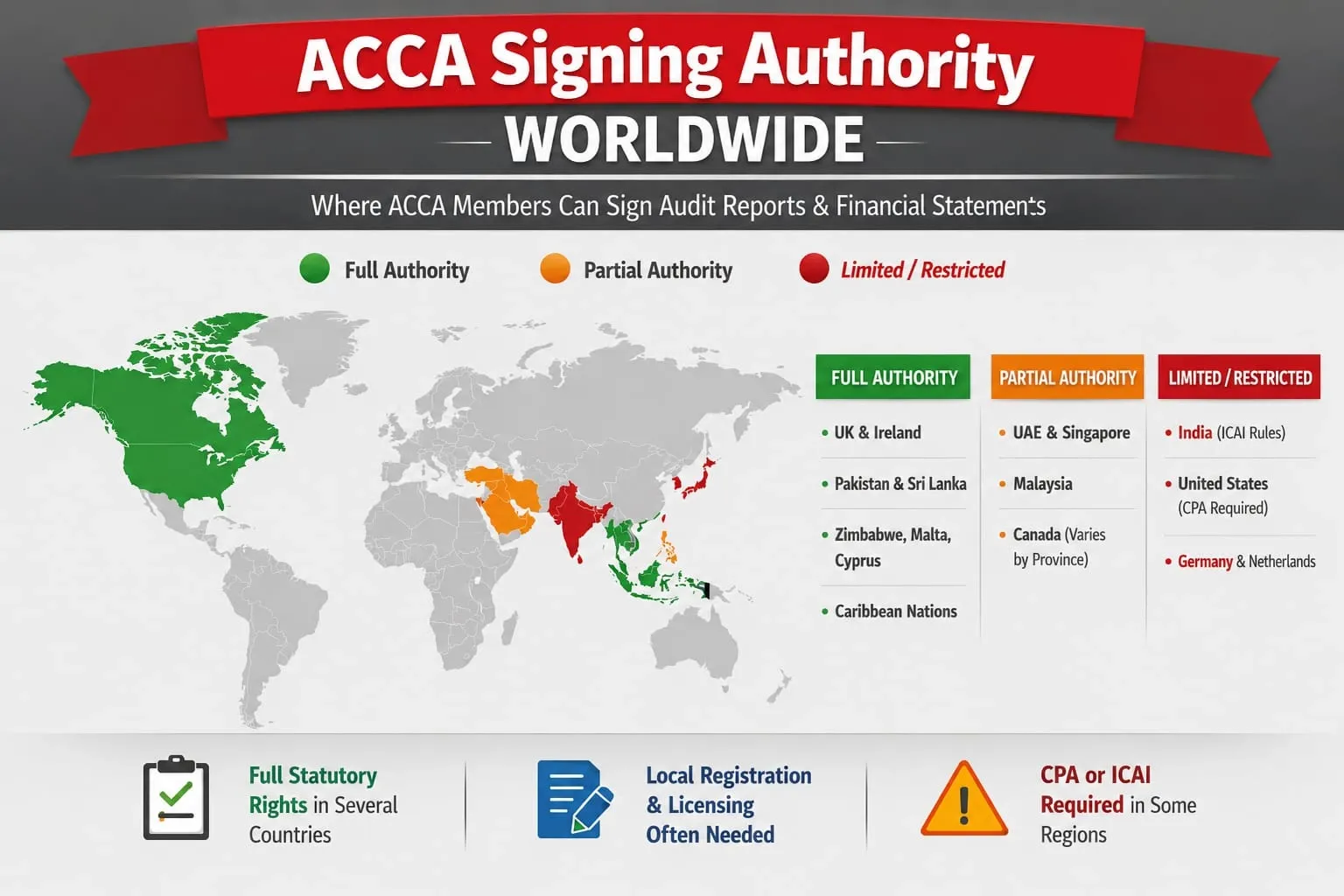
While the exams prepare you with global accounting knowledge, knowing where ACCA grants statutory audit rights helps students decide if they need to pursue additional local qualifications (like CPA in the US or ICAI in India) alongside ACCA to fully practice in their chosen country.
Top Recruiters Hiring ACCA Professionals
The demand for ACCA-qualified professionals spans a wide range of industries and employer types. The following are among the most prominent recruiters of ACCA professionals in India and globally.
| Employer Category | Major Recruiters | Common Roles for ACCA Professionals |
|---|---|---|
| Big 4 Accounting Firms | Deloitte, PwC, EY, KPMG | Audit, Tax, Advisory, Financial Reporting, Risk Management |
| Global Capability Centres (GCCs) & MNC Shared Services | JPMorgan Chase, Goldman Sachs, HSBC, Barclays, Deutsche Bank, Morgan Stanley, Citibank, Amazon, Google | Financial Reporting, FP&A, Product Control, Regulatory Compliance, Internal Audit |
| Indian Corporates & Conglomerates | Reliance Industries, TCS, HDFC Bank, ICICI Bank, Infosys, Wipro, Aditya Birla Group | Financial Reporting, International Accounting, Cross-Border Finance, Corporate Finance |
| Fintech Companies | Paytm, Razorpay, CRED | Compliance, Financial Reporting, Strategic Finance, Risk Management |
| Mid-Tier Global Accounting Firms | Grant Thornton, BDO | Audit, Advisory, Assurance, Financial Consulting |
Also Read: Salary Prospects and Careers after B.Com Finance ACCA
Is ACCA Worth It in 2026?
Is ACCA a professional course worth pursuing in 2026? For candidates with a clear orientation toward global finance, MNC roles, or international careers, the answer is a definitive yes. However, ACCA is not suited for every career path. Candidates who wish to practise statutory audit in India, specialise exclusively in Indian taxation, or build a career within traditional Indian domestic firms will find that the CA qualification holds a stronger position in those environments. The two qualifications are not competing alternatives in every context but they serve different professional objectives.
What are ACCA career opportunities after the course?
- Management Accountant: As a management accountant, you are responsible for analysing business and operational costs, preparing financial reports, and supporting management in making strategic business decisions.
- Credit Controller: A credit controller reviews and approves credit applications and manages customer credit accounts. They manage corporate debtors to ensure credit recovery and also assess customer creditworthiness, and monitor outstanding payments.
- Financial Accountant: Financial accountants record and analyse an organisation’s financial transactions. The financial statements are presented to business stakeholders for a better understanding of the organisation’s financial performance.
- Tax Specialist: The role of a tax specialist is to advise clients on tax laws and help them meet taxation requirements while ensuring compliance with applicable tax regulations.
- Finance Manager: These professionals manage the finance division of a company. They perform financial analysis, prepare strategic reports, monitor budgets, and identify investment opportunities by analysing market trends and cost management strategies.
Also Read: ACCA Career Opportunities: Top Jobs & Salaries
Take the next step in your career ?
Conclusion
If you are planning to build a strong career in accounting and finance, pursuing the ACCA qualification can open opportunities in global finance, auditing, taxation, and business management roles.
You can also check accounting and finance programmes offered by Amity University Online to build a strong academic foundation and support your long-term career goals in finance and business.
Check Out Our Top Online Degree Programs
ABOUT AUTHOR

Similar Blogs

Apply Now
Similar Blogs
Apply Now
frequently asked questions
What does ACCA stand for?
+ACCA stands for the Association of Chartered Certified Accountants. It is a globally recognised professional accounting body founded in 1904. It offers candidates the designation of Chartered Certified Accountant upon completing the qualification.
What is the ACCA qualification?
+The ACCA Qualification is broadly equivalent to a degree course if you pursue the first nine papers called the Fundamentals level. If you pursue the course at the professional level, it is equivalent to a master’s program.
What are the eligibility criteria for ACCA?
+You need to have completed 12th standard with any stream. Students with a commerce or math background find it easier, but anyone can apply. Graduates may get exemptions based on subjects.
Can I pursue ACCA after the 12th?
+Yes, you can definitely pursue ACCA after completing your 12th. It is open to school leavers, and you can start directly from the foundation or skill level, depending on your marks.
What is the duration of the ACCA course?
+The ACCA course usually takes around 2 to 3 years to complete. However, it can extend up to 3 to 4 years, depending on exam clearance speed and the exemptions you receive.
What are the ACCA fees in India?
+ACCA fees in India include registration, annual subscription, and exam fees. On average, per exam and overall stages, it can vary widely depending on attempts and exemptions, but costs are moderate.
What is the total cost of completing ACCA?
+The total cost of completing ACCA in India is usually around 2 to 4 lakh rupees. It depends on exemptions, exam attempts, coaching, and how quickly you clear all the papers.
What is the ACCA salary in India?
+ACCA freshers in India can earn around 4 to 8 LPA. With experience, it can grow significantly, reaching 10 to 25 LPA or more in global firms and senior finance roles.
Is ACCA better than CA?
+Neither is strictly better. CA is more valued in India, while ACCA has stronger global recognition. Choice depends on whether you want a domestic career or international finance opportunities.
Is ACCA recognised in India and abroad?
+Yes, ACCA is a professional course recognised by employers in over 180 countries by employers across industries such as consulting, banking, audit firms, multinational corporations, and financial services.